Tuesday March 17th, 2026 Queen Anne, Sydney, Australia
Updated: Mar 23
Another beautiful day in Sydney and we started out, once again, at the Belgian Café. Sitting outside we soaked up the atmosphere of the busy café and the throngs of visitors passing by on their way into the Rocks area – a great spot to people-watch. We also did a bit of bird watching as a local parrot decided to investigate the sugar options on our table, rifling through the packets he finally decided on a pack of brown sugar and flew up to the top of one of the umbrellas to enjoy his treat.
From the Rocks we took an Uber over to the Australian National Maritime Museum in Darling Harbor, the next bay immediately to the west of Circular Quay; I’d heard there was an exact replica of Captain Cook’s Endeavour at the museum, and I was keen to check it out. The museum is fairly modern, completed in 1991, and consists of a large exhibits space and a collection of ships moored in the harbor. Due to time constraints, I mainly focused on the ships and spent very little time inside the museum; there were 4 major vessels on display. A 35 AUD (about 25 USD) wristband is required to see all of the special exhibits and vessels.
The 19th century barque James Craig, a ship from that interesting crossover period from sail to steam, being steel hulled but fully rigged with sails; she has immense historical value as one of only 4 nineteenth century barques in the world that still regularly sails. The James Craig was built in 1874 in Sunderland, England, very close to my hometown; she was a workhorse ship taking cargo all around the world, rounding Cape Horn 23 times in the 26 years up to 1900. At the end of her life the ship was left to rot in Tasmania, eventually being intentionally sunk for safety reasons. Amazingly the ship was raised in 1972, and restoration was complete in 2001. We were met onboard by one of the wonderful volunteers who conduct tours and look after the ship. I found the James Craig to be very well restored; the interior spaces were outfitted with original materials and signage offered hints as the function of each room. One major change for the restoration was the addition of a deck to essentially split the original large cargo hold into two more functional decks. This ship is well worth a visit of you are at all interested in the age of sail.
The Oberon-class submarine HMAS Onslow was introduced into RAN service in 1969 and operated until early 1999. I toured the Onslow and thought it was brilliant; I’ve always had a fascination with submarines and have only once before had the chance to tour inside one. Entry to, and movement within, the Onslow required a little bit of awkward body maneuvering, with steep ladders through small hatches and clambering over the threshold of watertight door openings. If you are at all claustrophobic, like Sandra, I would not recommend touring the inside of a sub. The Onslow was the last of 6 Oberon-class subs that the Australian government ordered from the British government; she was built in Greenock, Scotland, the town where Sandra met and I lived before we moved to the US. Most of the interior equipment is still in place and several volunteer guides were on hand to explain things. Although I was left wondering at the knowledge of the volunteers when the young man at the periscope was explaining that the sub could run underwater for months at a time, even running its diesel generators while submerged – a feat I believe is technically impossible. Operating during the height of the cold war this sub used diesel generators to charge its batteries, while on the surface or at periscope depth, and enable very quiet submerged running on electric motors. It’s remarkable to think that 68 men lived and worked in such tight, cramped conditions. I’d go back in a heartbeat.
HMAS Vampire, a destroyer commissioned into the RAN in 1959, and served until 1986. She spent most of her career in southeast Asia, including during the Vietnam War. In 1977, the destroyer was assigned to escort the royal yacht HMY Britannia during Queen Elizabeth II and Prince Philip's visit to Australia. Given my time constraints I did not get to see much of the Vampire, as my interests lie more in ships from the age of sail – I crossed over Vampire and boarded the barque Endeavour.
HMB Endeavour Replica is a replica of HMS Endeavour, the bark commanded by Lieutenant James Cook when he charted New Zealand and the eastern coast of Australia in 1770. At this point I must confess to being a huge fan of the navel historical novels set in the age of fighting sail; the works of Patrick O’Brien (Jack Aubrey series) and C.S. Forester (Horatio Hornblower series) plus many others have entertained me for many years, I must have read at least 50 books of this genre. I thought this vessel was just remarkable, the level of detail that went into its creation is breathtaking. Again I opted for a self-guided tour and descended to the hold and crew areas via a hatch at the bow and worked my way back to a hatch at the stern – many ladders and knotted ropes, it was brilliant. In this day and age of GPS navigation and easily accessible world travel it’s hard to comprehend what Cook and his crew must have thought as they left Tahiti, which has pretty much where the known world ended, and set their course west into completely uncharted territory. They discovered and charted the entire coasts of both New Zealand islands and then again headed west and charted the entire east coast of Australia – all in a small former collier that had been converted for the exploratory voyage. It’s hard to not be in awe of such magnificent achievements, and visiting the HMB Endeavour really helped to fire my imagination.
After a brief huddle in the Maritime Museum we decided to make our next port of call the Art Gallery of New South Wales located near the Botanical Gardens on the edge of the Woolloomooloo district (isn’t that the best name for a city district you’ve ever heard?), about a 15 minute Uber ride away. The gallery's first public exhibition opened in 1874, admission is free to the general exhibition space, which displays Australian art. I’d heard about a special exhibit by the hyperrealist sculptor Ron Mueck which looked really interesting and so, entering through the impressive columned façade, we headed for the information desk to find out where the special exhibition was located. Following some very murky directions we ended up wandering through the museum and got to see some very fine pieces but could not locate the special exhibition. After a brief lunch in the museum’s café, and some renewed directions, we then realized that the museum consisted of two entirely separate buildings; the original one and a newer, unconnected, one next door. The special exhibit was in the newer building and so we had to exit the old building and walk about 50 yards to the new building – it’s quite baffling that they would not have connected the two buildings in some way. Admission price for the special exhibition was 35 AUD (about 25 USD).
I have to admit I’d never heard of Ron Mueck; he was born in Melbourne in and grew up in the family puppetry and doll making business before moving to work in the film and advertising business in the US – he now lives and works in England. The exhibition was very interesting, consisting of a series of sculptures of people in an array of situations displayed in huge museum spaces – there were only 8 pieces throughout the entire, gigantic exhibit area. The only non-human sculpture consisted of a pack of fighting dogs each scaled up to an enormous size, it was pretty scary. Mueck’s work is so realistic – though I don’t think a single piece was made to actual size: some scaled down some up, but all produced with a barely believable level of detail; every toe, every wrinkle, every vein, every eyelid. Nothing is overlooked. I would not have been surprised if one of then suddenly got up and walked away. My favorite was Chicken/Man depicting an angry man sat at a table apparently arguing with a chicken standing on the opposite end of the table. It’s interesting to note that the painstaking nature of his work means Mueck has made fewer than 50 sculptures in the past three decades. I enjoyed this exhibition immensely.
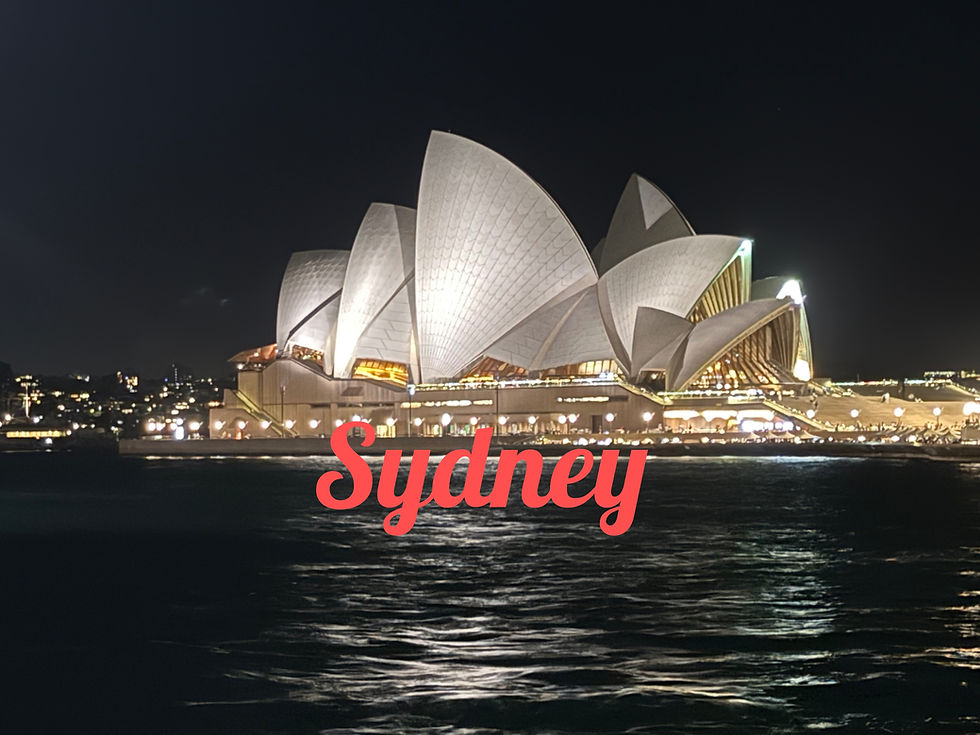
The sail away from Sydney was amazing, we watched from our balcony as the Queen Anne lifted off her berth and backed out into the harbor just opposite the famous bridge. We could pick out the brave souls doing the “bridge climb”, tiny stick people protruding from the superstructure of the bridge – we could even hear then calling to us after the ships horn had sounded her farewell to the city. With the sun beginning to set, and as the ship turned to port, we were treated to a magnificent view of Sydney behind Circular Quay and then the Opera House as we began to make headway towards Hornby lighthouse and then North Head before, once more, passing into the Tasman Sea.
We had an absolutely fabulous time in Sydney, and we agreed to make it one of our favorite places to visit, vowing to return again in the not too distant future.
The Belgian Cafe Parrot stealing sugar Cheeky bird enjoying his brown sugar National Maritime Museum National Maritime Museum The James Craig The James Craig The James Craig The James Craig The James Craig HMAS Onslow HMAS Onslow Descending into the sub Descending into the sub Forward torpedo tubes Watertight hatch Bunks on the Onslow Bunks on the Onslow Periscope Fire control station (for launching weapons) Diesel generators Exit hatch HMB Endeavour HMB Endeavour HMB Endeavour HMB Endeavour HMB Endeavour Steep stairs and knotted ropes Me at the helm HMB Endeavour Art Museum of New South Wales Art Museum of New South Wales Art Museum of New South Wales Art Museum of New South Wales Art Museum of New South Wales, concourse of new building Mueck: Pregnant Woman Mueck: Mother and Child Mueck: Mother and Child Mueck: Ghost Mueck: Ghost Sparse rooms Mueck: Woman with Sticks Mueck: Chicken / Man Mueck: Crouching Boy in Mirror Mueck: Chicken / Man Sparse rooms Mueck: Big Man Mueck: Big Man Mueck: Havoc Those dogs are pretty scary! Mueck: Havoc Mueck: Couple Under Umbrella People climbing the Sydney Harbour Bridge Sydney Opera House Circular Quay with Sydney in the background


Comments